


Key Considerations for Saddle Fit

Your saddle is where communication becomes connection.
I like to check the following with no saddle pad, as pads can hide minor fit issues. Please ride with a saddle pad. Ensure your horse is standing square while you check your fit.
Saddle Balance
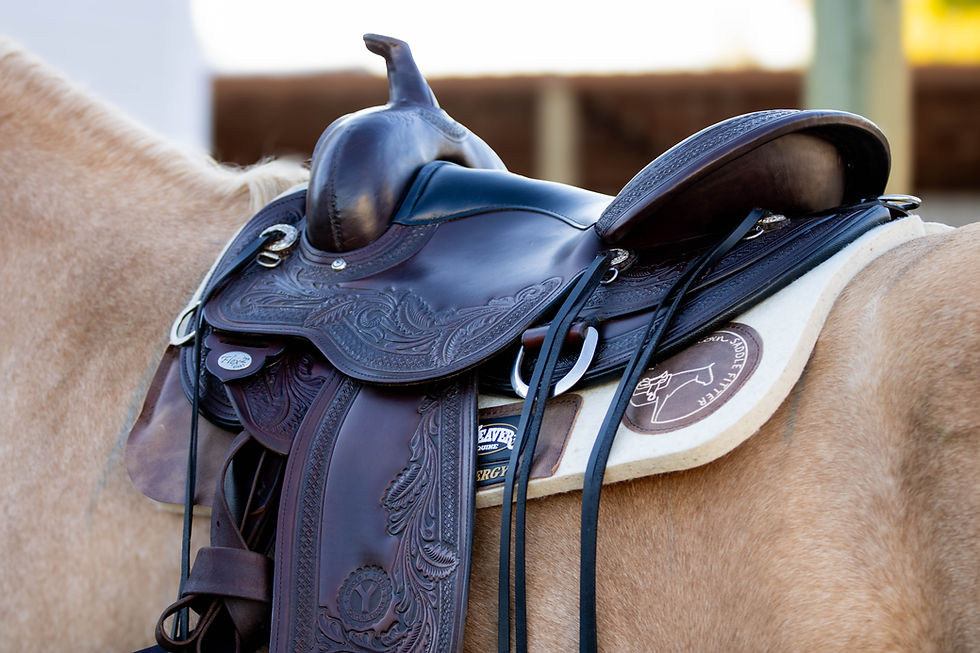
See the front concho/D-ring on your saddle? This is the start of the support area of your saddle bars. Line this up just behind your horse’s shoulder.
Look at the stirrup bar on your saddle. Is it parallel to the ground?
Lower in front? The saddle will push you forward and put pressure on your horse’s shoulder and withers
Higher in front? The saddle will put you in a chair seat and increase the pressure on your horse’s loins
Wither Clearance
Using your fingers, measure how many you can fit between your horse’s withers and the bottom of your saddle’s fork/pommel vertically and on each side from the edge of your horse’s spine to just above where it meets the top of the saddle panels.
You want to be able to fit 2-3 fingers’ clearance all the way around.
Less than 2? There is not enough wither clearance.
4 or more? You may have too much wither clearance, especially if the front bar angle of your saddle is too steep for your horse (Don’t worry; we’re going to take a look at that, too).
Gullet Channel Clearance & Saddle Tree Width
Check from the front and back of your saddle. You want at least 2 fingers of vertical clearance from your horse’s spine and roughly 4 inches of space between the tree bars (approx. the width of your fist).
Get your hand all the way underneath the front of your saddle and feel the top of the tree bars contacting your horse.
No wither clearance? Tree width is too wide.
Tight on the sides? Tree width is too narrow.
The right width allows your horse’s shoulder blade to slide through underneath the saddle. and ensures spine clearance.
Tree Bar Contact
Put the back of your hand flat against your horse. Run it along the horizontal bars of your saddle tree on each side.
Starting at the front of your saddle, ensure there is no pressure between your saddle and your horse when you run your hand along under the front of the saddle in front of that first concho/d-ring (you may feel the saddle bars but they should flare away from your horse).
You are looking for even pressure from that first concho/d-ring to the back of your cantle. Beyond your cantle, the bars should flare away from your horse again and have no pressure.
Under that middle section where you want even pressure, watch for Rock (more pressure in the middle with less in the front and back) or Bridging (Pressure in the front and back of your saddle bars but not in the middle).
Saddle Tree Angle
Your horse’s shoulder angle and your saddle’s bar angle need to be parallel.
To determine the angle of your saddle’s bars, rest a pen or whip parallel to your saddle piping where the front of the saddle bars are (the bottom flap if your saddle has two).
To determine angle of your horse’s shoulder, rest a pen or whip on the horse’s shoulder at it’s widest point, in front of where the saddle bars sit.
Are the two pens or whips parallel?
If the saddle angle is wider than your horse’s shoulder, it will put pressure on the withers.
Steeper saddle angle? The scapula will get damaged and push the saddle back onto your horse’s lumbar area, often causing them to crow hop/buck.
I am typically comfortable with up to a 5 degree difference between the saddle angle and the angle of they horse's shoulder at it's widest point.
Saddle Length
The length of the portion of the saddle tree bars contacting your horse is crucial.
You don’t want the contact portion of your saddle bars to extend beyond where your horse’s ribs connect to their spine.
While not an exact science, the most straightforward way to find this is to find where the hair on your horse’s side changes direction to point down and go up vertically from there.
The part of your saddle bars making contact with your horse should not extend beyond this point and any additional bar length should match or flare up from the shape of your horse’s back.
The pressure from too long a saddle will lead to a bucking response from your horse.
Saddle Straightness
Your saddle should sit straight on your horse’s back to provide clearance for spine both in movement and at rest.
Look at your saddle from behind in comparison to your horse’s spine. Does it sit at a diagonal with either the front or the cantle falling to one side?
Perhaps the whole saddle falls more to one side or the other.
Note, the decorative stitching or tooling at the top of your cantle may not be symmetrical. Look at your saddle channel from behind for alignment.
It’s not uncommon for horses to be asymmetric through their shoulders (usually the side with the smaller shoulder is the side that the bottom of a horse’s mane falls to).
Rigging / Billet & Cinch / Girth Placement
With rigging/billets, Gravity Rules.
Look at your horse from the side.
Under their belly you will see a flat line starting between their front legs before you hit the swell of your horse’s belly (if your horse is on the thinner side, you can palpate). This is where your horse’s sternum is.
You want your cinch/girth lying naturally on top of the sternum, in this girth groove.
Your cinch/girth will naturally end up there during movement. If your cinch/girth starts off too far forward, your horse’s movement will push the saddle back onto the lumbar. If it starts too far back, your saddle will get pushed into your horse’s shoulder scapula during movement
Have a back cinch? You don’t want it too tight, as the solar plexus is sensitive. Too loose and the horse risks catching a leg under it in movement.
Other Considerations: Saddle Pad & Cinch/Girth Length and Shape
These are general tips to get you started. They are not meant to replace advisement by a professional. Not sure where to start? Just reach out.


Comments